

Can Artificial Intelligence Get Sick?
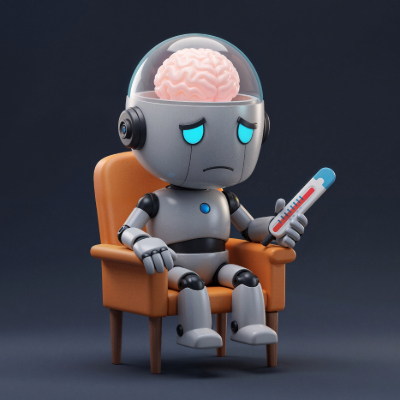
Artificial intelligence is all the rage these days. In fact, most businesses are using it for a multitude of things. With everyone all-aboard the AI train, it’s easy to confuse the computational power and speed AI offers to be infallible. Unfortunately, AI can get things going sideways if you aren’t careful. When it does go wrong, the consequences can be more than just an inconvenience.
Here’s a look at some of the most critical ways AI can go wrong:
The Problem of AI Bias and Discrimination
This is perhaps the most well-known danger. AI systems learn from the data they are fed, and if that data reflects societal prejudices, the AI will not only learn those biases, but because of the amount they are used, end up amplifying them.
AI has been shown to unfairly deny loans to people based on their zip code, exhibit higher error rates in facial recognition for darker-skinned individuals, and create racially biased predictive policing or healthcare models. This can be used to significantly deepen social and economic inequality.
Do you remember the case of an Amazon recruiting algorithm that reportedly discriminated against women? Since the system was trained on historical data, which mostly came from male engineers, it learned to penalize resumes that included the suggestion of the female gender, ultimately screening out qualified applicants.
Public exposure of a biased system can lead to severe reputational harm and a loss of customer trust that is difficult to repair. This is largely because complex AI and deep learning models operate as black boxes and their decision-making process is so opaque that even the engineers who built them can’t fully explain how or why a particular conclusion was reached.
If an AI system recommends a medical treatment, plays a role in the wrongful conviction of a defendant, or denies a claim, and no one can explain the reasoning, trust in that system—and the institutions using it—collapses.
LLMs can confidently generate completely false information, sometimes called hallucinations. Remember that lawyer who recently faced a court sanction for submitting a brief that cited non-existent legal cases fabricated by an AI chatbot, and then doubled down with an AI-fueled apology? Imagine that error applied to medical advice or financial planning.
For businesses, it can be an accountability nightmare. In the event of an AI-driven failure (e.g., an autonomous vehicle accident or a system-wide financial error), determining liability becomes a tangled legal mess without transparency into the system’s decision-making.
Businesses relying on an unexplainable model for supply chain or demand prediction are operating on blind faith. If the decision is wrong, there’s no way to debug the logic and prevent it from happening again.
Automation through AI is often lauded for boosting efficiency, but it carries a very real risk of eliminating jobs, particularly in roles involving repetitive tasks. While AI may create new, highly-skilled jobs, those who lose their current roles may not have the skills or resources to transition. This can lead to increased socioeconomic inequality.
The power of AI is also a double-edged sword. As it becomes easier to use, it also becomes a powerful tool in the hands of bad actors and can dramatically accelerate the number of successful cyberattacks, creating more convincing phishing scams and finding vulnerabilities in a system much faster than a human.
Responsibility is Key Moving Forward
The risks posed by AI are not reasons to halt innovation, but rather a powerful call for responsible development and deployment. For AI to be a net positive for society, businesses and developers must prioritize a strategy of testing AI models on diverse datasets to proactively identify and correct discriminatory outcomes. Also, businesses need to establish clear, thoughtful regulations that assign responsibility when AI systems cause harm and ensure ethical standards are met. AI is a reflection of the data and values we feed into it. It is up to us to ensure that reflection is one of fairness, safety, and accountability.
For more information about AI integration and more innovative technologies, give the IT experts at White Mountain IT Services a call today at (603) 889-0800.